The art of saying difficult things well
Clarity is often misunderstood. People sometimes assume that to make writing clearer, you have to make it simpler: shorter sentences, easier words, fewer layers of thought. In some cases, that may be true. A sentence that has tied itself into a decorative knot probably does need to be untangled. A paragraph wandering off the path may need someone to call it back before it disappears entirely.
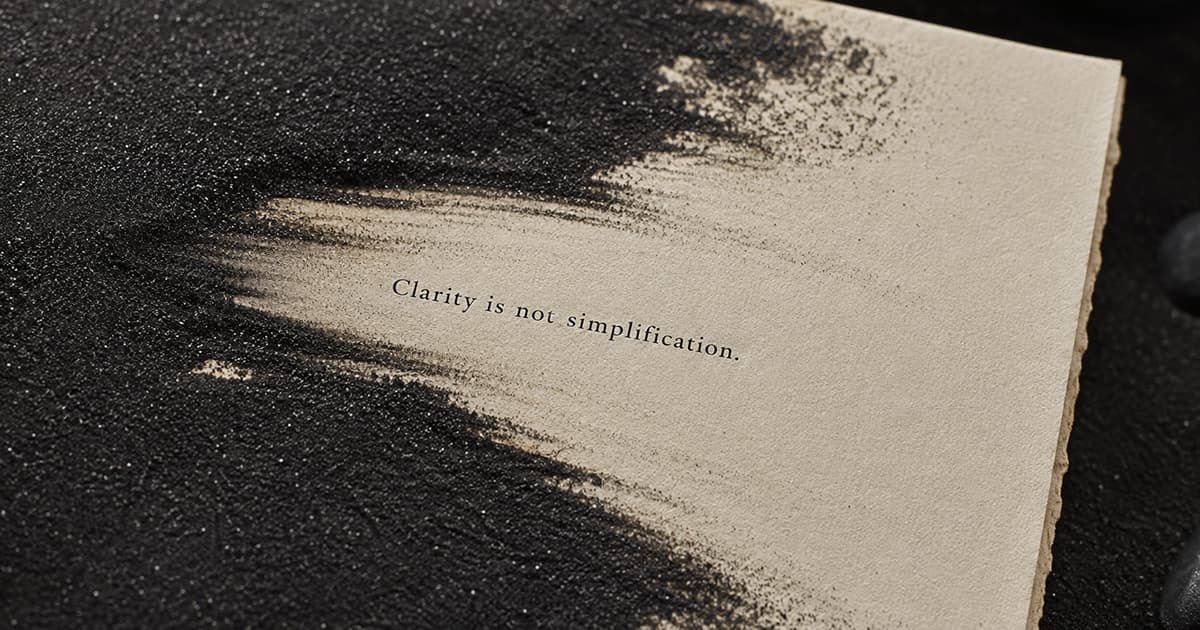
But clarity is not the same as simplification.
In academic, professional, and creative writing, the aim is not always to make something easy. Some ideas are complex because they need to be. Some arguments require nuance, precision, tension, and careful movement from one point to the next. The goal of good writing is not to sand everything down until it loses its grit. It is to make the shape of the thought visible, and let it stand in better light.
The problem with “just make it simpler”
As an editor, I often encounter the assumption that the solution to difficult writing is to “make it simpler.” This can be useful advice when a sentence is overburdened with unnecessary abstraction, repetition, or jargon. But it can also become reductive.
Some writing is not unclear because the ideas are too complex. It is unclear because the relationship between those ideas has not been fully expressed. The problem may not be the vocabulary, but the structure. It may not be the length of the sentence, but the order in which information is introduced. It may not be the argument itself, but the missing connective tissue between one claim and the next.
A complex idea can be expressed clearly without being reduced to something smaller than itself. In fact, the more complex the idea, the more carefully it needs to be handled.
Academic writing makes this especially visible. Precision can matter more than speed; the right word may need to appear again, even if a synonym would look neater. A small distinction may be carrying more weight than it first appears to. And a long sentence is not always a sentence that has lost control. It may be holding several relationships in balance; cut it into smaller pieces too quickly, and the meaning can end up chopped apart with it.
The question is not always, “Can this be simpler?” Sometimes, the better question is, “Can this be more exact?”
Clarity as a form of respect
Clear writing is generous writing. It respects the reader’s time, attention, and intelligence. It does not make the reader work unnecessarily hard to understand what is being said.
But this does not mean that the writer has to spoon-feed the reader or strip the writing of sophistication. A reader can be challenged without being confused. They should be invited into a demanding idea, instead of being left outside in the rain, peering through a foggy window at what appears to be a very important dinner party.
Good clarity creates a path. It gives the reader enough guidance to follow the movement of the thought. It signals where the argument is going, why a detail matters, how one idea connects to another, and what the writer wants us to understand by the end. It does not drag the reader along by the wrist, but it does not leave them stranded either.
This is where editing becomes more than correction. It is not only about fixing grammar or smoothing awkward phrasing. It is about recognising what a piece of writing is trying to do, and helping it do that more effectively.
When elegant writing becomes obscure
There is, of course, a kind of writing that hides behind elegance. Beautiful words can create the impression of depth even when the meaning is vague. Long sentences can sound impressive while saying surprisingly little. Abstract nouns can pile up until the reader has the feeling that something important is being said, without being able to identify exactly what it is.
This is one of the dangers of polished but unclear writing: it can disguise uncertainty.
Many writers do this without realising it. When we are unsure of our argument, we may instinctively reach for more elaborate language, dressing hesitation as sophistication. We add layers where we need direction, soften claims that need force, and circle the point rather than landing on it. The result may sound intelligent, but it does not quite communicate: a locked door with a very impressive handle.
True elegance is different. It is not decoration placed over uncertainty. It is style shaped by meaning.
Elegant writing has rhythm, but it also has direction. It can be subtle, but it is not evasive. It can carry complexity, but it does not use complexity as a shield. The beauty of the language comes from the accuracy of the thought.
The voice is part of the thought
There is another risk in the pursuit of clarity: the loss of voice. Sometimes writing is made “clearer” in a way that makes it generic. The sentences become technically correct, but something human disappears. The rhythm becomes flatter. The writer’s personality, emphasis, and intellectual texture are smoothed away. Nobody has technically died, but the room has gone cold.
This is where I think editing requires particular sensitivity. The task is not to make every text sound the same. It is not to impose a single model of “good English” onto every writer. A philosophical essay, a literary analysis, a business proposal, and a personal reflection should not all move in the same way. Clarity has to serve the text itself.
For one writer, clarity might mean more direct sentences. For another, it might mean preserving a lyrical cadence while removing ambiguity. For an academic, it might mean sharpening the argument without erasing necessary nuance. For a non-native English speaker, it might mean making the prose sound natural while keeping the writer’s own intellectual and imaginative voice intact.
The aim is not to replace the writer’s voice with the editor’s, but to help that voice ring true.
The hidden structure of clear writing
Clear writing feels effortless when we read it, but there is often an invisible framework holding everything in place. A strong paragraph usually knows where it is going. A strong sentence usually knows where its emphasis falls. A strong argument usually gives the reader enough orientation to understand not just what is being claimed, but why it matters.
When writing feels unclear, it is often because this underlying structure has weakened. The ideas may all be there, but they may not be arranged in the order the reader needs. The most important point may be buried; a transition may be missing; a sentence may be trying to do four different things at once, which is brave, but rarely advisable.
Editing, in this sense, is a form of attentive reading. It means listening for the places where the writing hesitates, doubles back, overreaches, or loses its thread. It means asking not only whether a sentence is correct, but whether it is doing the right job in the right place.
Clarity without loss
The best writing is not always the simplest writing. Sometimes it is still rich, layered, subtle, or intellectually demanding. It may ask something of the reader; good writing often does. But it should give the reader enough to follow: a path through the argument, a sense of why each detail matters, and a way to stay with the thought as it develops.
That is the kind of clarity I value most: not the kind that tidies the life out of a sentence, but the kind that lets the reader see what was already there. The nuance remains. The voice remains. The difficulty, if it belongs there, remains too.
Good editing does not make writing behave itself for the sake of appearances. It listens for what the text is trying to become, then clears enough space for it to get there.
Language does not have to lose its grit to be made clear. Sometimes it only needs the dust lifted from it.